Growing with Pantheon's Platform Options
- Development
- Strategy
- Design

(01)The Challenge
When the site model drifts from the editorial reality
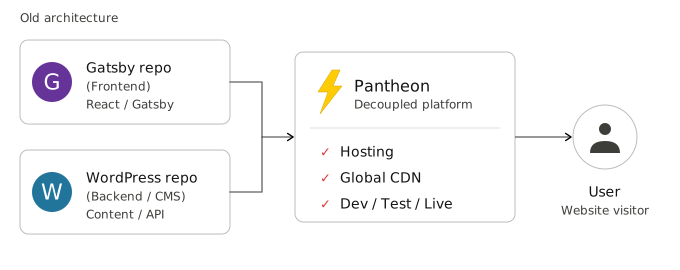
fastforward.sh has been a Pantheon site for years. It started on Pantheon's standard hosting, moved to Pantheon's Decoupled Sites platform when we wanted a faster front-end — a Gatsby 4 build feeding off headless WordPress over WPGraphQL — and stayed there as we shipped, iterated, and grew the team.
What we didn't notice for a while was that the editorial workflow underneath the site had quietly shifted. Copy edits were happening in Google Docs, not in the WordPress admin. Case studies were authored by our marketing team, sent to our developers to place in Wordpress, then sending back preview links. The team that the CMS was meant to serve had stopped logging into it; the developers were the ones maintaining a tool nobody was using.
The site model and the editorial model had drifted apart. The real question wasn't "how do we modernize the front end" — it was "what shape of platform actually fits how this team works now?"

(02)The Approach
Match the platform to the editorial workflow
Three options were on the table.
- Option 01
- Keep WordPress as the CMS and refresh the Gatsby front-end — the smallest disruption, but it preserved the original mismatch.
- Option 02
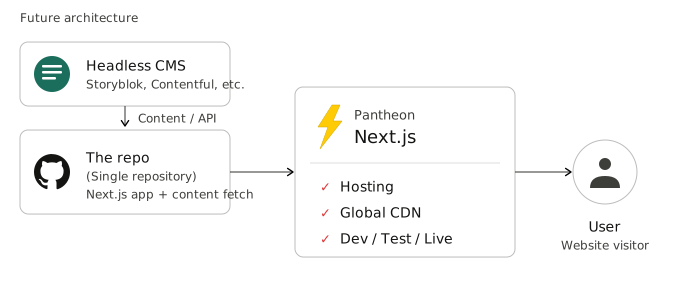
- Trade WordPress for a modern headless CMS like Sanity or Contentful — better editorial UI, but still a runtime dependency for a team that had stopped using runtime CMS UIs.
- Option 03
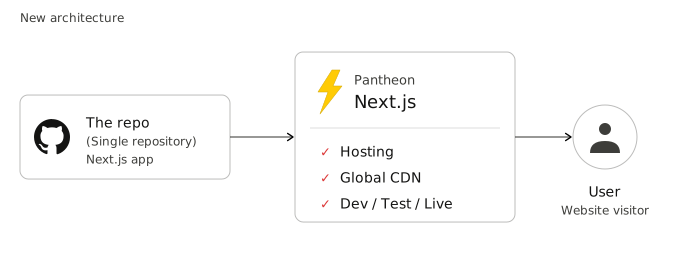
- Drop the CMS entirely, store content as MDX and YAML in the repository, and move from Pantheon's Decoupled Sites platform to Pantheon's Next.js platform.
We chose option three. It was the only one that aligned the site model with what the editorial team had already become — a small, technical group editing content the same way they edit code. Putting content in version control gives us atomic deploys, code review on copy changes, instant rollbacks, and a build that is fully deterministic from the repository state alone — for free.
Importantly, this wasn't a re-platform. It was a shelf change. Pantheon's offering had grown alongside us. The Decoupled Sites shelf fit when we needed a headless CMS feeding a static front end; the Next.js shelf fit when our editorial reality outgrew the headless CMS. Same vendor, same operational model, same CDN, same environment promotion — just a different platform shape underneath.
(03)The Stack
Pantheon Next.js, fully static, modern foundation
The new site runs on Next.js 16 with the App Router, React 19, and TypeScript. Styling is Tailwind CSS 4 in CSS-first mode — design tokens live in an @theme block in app/globals.css, and there is no tailwind.config file at all. Typography is loaded through next/font/google with size-adjust fallback metrics, so Manrope and JetBrains Mono swap in without the layout shift that used to plague font loading.
Content is plain MDX and YAML in content/. A build-time loader reads it synchronously with gray-matter and js-yaml, returns typed objects, and feeds them into statically-generated routes. Every marketing page is rendered to HTML at build time and served from Pantheon's CDN. The only runtime surface is a single API route — the contact form posts to a Monday.com Leads board.
The hosting move kept everything that worked about Pantheon and swapped only what needed to change. The platform builds the site from the GitHub repository on every push to main; promotion from Dev to Test to Live runs on the same tag-based model the team has used for years. The runtime is now containerized Node instead of PHP, the front end is Next.js instead of Gatsby, and the database is gone entirely — but the operator's mental model didn't move.

(04)How We Built It
Pantheon's CLI as the connective tissue
The day-to-day work of running a Pantheon site has always lived in Terminus, Pantheon's command-line interface. Cloning a fresh database from Live to Dev, spinning up a multidev for a feature branch, running drush against a Drupal environment, clearing the CDN after a deploy — all of it is one Terminus command away, and the same commands work across the Drupal sites, the WordPress sites, and now the Next.js site we maintain. The platform's CLI is the connective tissue that makes a multi-platform Pantheon reality feel like a single operations surface.
That muscle memory carried straight into the migration. Every multidev cut for a risky migration phase was a one-line terminus multidev:create. Every CDN invalidation after a Test or Live deploy was a single terminus env:clear-cache. Pantheon's environment model — the same Dev/Test/Live promotion shape we've worked with for years across other platform shelves — held the entire port together.
The migration itself was structured as seven phased rewrites, one focused effort per concern (scaffold, content export, content loader, page rendering, contact form, SEO, pre-flight). Each phase produced a single, reviewable commit. The WordPress content was moved with a re-runnable, idempotent script that hit the WPGraphQL endpoint, mapped ACF flex-content blocks to a YAML discriminated union, downloaded media into public/ with eight-way concurrency, and wrote a migration report. Every time the WordPress install changed during the port, "what's new since yesterday" was a re-run plus a git diff.
For visual review — the failure mode that matters most for a brand site — we deliberately did not install Playwright, Percy, or Chromatic. A static marketing site fails visually, not logically; type-checking and lint don't catch a too-tight headline or a logo on the wrong background. Instead we run a five-point spot check defined in DESIGN.md against a live dev server, and lean on the Pantheon Test environment as the real safety net before promotion to Live. Match the test surface to the failure mode.
(05)The Result
One repository, no CMS, still on Pantheon
Two repositories and three services were replaced with one repository and zero runtime dependencies. The CMS database is gone. The GraphQL layer is gone. The plugin update treadmill is gone. Content edits are pull requests. Deploys are atomic. The site is fully statically generated and served from Pantheon's CDN, with one server-rendered route for the contact form.
The operations model, on the other hand, is unchanged. The team still uses Terminus for everything that touches an environment. The same Dev/Test/Live promotion model that has carried us across multiple Pantheon platform shapes carries us forward — and when the editorial reality eventually shifts again (a return to a CMS for non-technical editors, a new Pantheon offering, a different content shape entirely), moving shelves remains a tractable operation rather than a full re-platform.
The lesson, in one line: match the site model to the editorial team, and pick the platform shape that supports it. For us, that meant the Pantheon Next.js shelf. For the next site, it might mean something else entirely. The point is that Pantheon's platform menu keeps growing alongside the shapes our work takes.
(06)Behind the Curtain
Technical Notes
Every brand token — colors, type scale, container width — lives as a CSS custom property in the @theme block of app/globals.css. Tailwind v4 generates utilities from those tokens automatically (bg-ff_red, text-ff_black, max-w-ff_siteWidth) with no JavaScript configuration. Reusable effects — the brand's signature linear and radial gradients, the animated underline treatment, the hand-rolled hamburger icon — are declared as Tailwind v4 @utility blocks so they pick up responsive variants.
The content loader uses gray-matter for MDX frontmatter and js-yaml for service taxonomies and settings. The block taxonomy from the WordPress side (MainSection, ImageBlock, ClientQuote) maps cleanly to React components, so the mental model from the old codebase carries forward into the new one without a translation layer.
Two routes are dynamic at runtime — app/api/contact/route.ts for form submissions, and app/contact-submitted/page.tsx, which reads searchParams. Everything else — homepage, our-work index, project detail pages, dynamic content pages, the contact form view, sitemap, robots, manifest, icon — is prerendered at build time and served from Pantheon's CDN.